Friday, August 28, 2015

Fitting In and Finding Your Way...

Young Canadian singer songwriter Aleesia Cara is a poet. Her first song "Here" is a wonderful sarcastic apology to the popular crowd for not fitting in at a party:

 
"I'm sorry if I seem uninterested
Or I'm not listenin', or I'm indifferent
Truly I ain't got no business here
But since my friends are here, I just came to kick it
But really I would rather be at home all by myself"

I think it's a great prompt for discussion groups to consider (full lyrics) and / or a prompt for a quick write as we get to know our students early in the school year. 

Prompts:

1. How much do you connect with Aleesia Cara's feelings in her song "Here"?
or
2. If you were a friend of Alessia Cara's how might you respond to her after hearing her song "Here"?

Wild Things by Alessia Cara

Where_The_Wild_Things_Are_(book)_cover.jpg
Cara's second released song "Wild Things" (full lyrics) builds on the theme with thoughts about high school cliques. It's a terrific call to arms, full of great word play and connections to Maurice Sedac's classic children's story.

Prompts:

  1. Identify a character from a text we’ve read in class and explain how he/she would respond to Alessia Cara’s song. Justify your analysis with specific references to the character’s actions and/or thoughts.
  2. A “lamentation” is a song about regret and loss while a “celebration” is a song about success and triumph. Explain which label you’d apply to Alessia Cara’s “Wild Things”.
  3. How is Alessia Cara’s “Wild Things” related to the classic children’s story “Where the Wild Things Are” by Maurice Sedak?


"I lose my balance on these eggshells you tell me to tread
I'd rather be a wild one instead
Don't wanna hang around the in crowd, the cool kids
I'm cool to me, cause they're not cooler than we are"

Tuesday, August 25, 2015

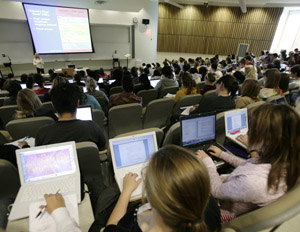
Effective Laptop Use in Classes

I think all of the following statements are probably true:

  • laptops can lead to off task behaviour in class / particularly during lectures;
  • laptops are great tools for taking notes during lectures;
  • laptops can lead to students transcribing lectures rather than summarizing / distilling the most important information;
  • laptops enable critical thinking, fact checking, making connections and exploring ideas during lectures;
  • the effective use of laptops in classrooms must be taught through modelling, discussion, and reflection.
These articles from the Globe and Mail and The Atlantic about technology use in university lectures might be useful starting points for a discussion in high school classes about the effective use of laptops for note taking:  "Professors at odds over technology’s role in the lecture hall" / "To Remember a Lecture Better, Take Notes by Hand"

Questions I'd want students to consider after reading the articles:


  1. How is effective note taking different from transcribing a lecture?
  2. How might laptops help or hinder effective note taking?
  3. What does effective laptop use look like in a class?
  4. Do high school teachers and university professors have different responsibilities in the regulation of laptop use in their classes?
  5. How will you know if you're an effective note taker?

Monday, August 24, 2015

Awkward Silences


featured-large-1503-620x320.jpg


I wonder if we spend enough time building relationships in our classes? I find that in many of the classes I visit the students don't know one another's names. This activity: "Awkward Silences", introduces students to the art of initiating a conversation using an article by Andrew Tarvin "Fifty Questions to Get to Know Someone - Quatro's Tips." It might be useful during the first couple of weeks of class.


Thursday, August 13, 2015

Narrative Profile of Amaris Tyynismaa

Amaris Tyynismaa has battled tourette's syndrome most of her life. Writer Duncan Murrell's profile of Amaris is a terrific example of the use of narrative to illustrate the qualities of a character.

"Amaris Tyynismaa: The Human Body is a Miracle. The Human Body is a Curse" by Duncan Murrell

Students might use the article as an example to follow when writing a brief profile of themselves.
1. Challenge the students to identify examples from the text when Murrell uses brief stories to illustrate key points about Amaris' personality or struggles.
2. Ask the students to consider how the use of the anecdotes make the story more interesting or convincing.
3. Challenge the students to share in small groups stories that illustrate something about themselves.
4. With just a partner follow up on the small group discussion with an interview focused on these ideas:

  • Identify something important / interesting people should know about your partner;
  • Discover an anecdote to illustrate the important / interesting thing;
  • Conclude your profile connecting the idea and the anecdote
Classroom friendly version of the article: A Runner


Saturday, June 6, 2015

Learning & Studying Tips

Exams are around the corner.  This article ("The Lessons You Never Got Taught In School") offers students some suggestions on how to take control of their studying success.

Best Tip: Students preparing for exams should use the "Elaborative Interrogation" method

From the article:

Elaborative Interrogation

A method involving creating explanations for why stated facts are true. The method involves concentrating on why questions rather than what questions and creating questions for yourself as you are working through a task. To do this yourself, after reading a few paragraphs of text ask yourself to explain “why does x = y?” and use your answers to form your notes. This is a good method because it is simple, so anyone can apply it easily. It does however require enough prior knowledge to enable you to generate good questions for yourself, so this method may be best for learners with experience in a subject. The technique is particularly efficient with regard to time, one study found that elaborative learning took 32 mins as opposed to 28 mins simply reading.
An example of elaborative interrogation for the above paragraph could be:
Elaborative learning is useful for proficient learners because it allows them to apply their prior knowledge effectively to process new information. It is rated as effective because it is time efficient and relatively easy to perform.

Thursday, June 4, 2015

Book Clubs with Purpose

Literature Circles with defined roles can be a useful structure to support students' understanding of the sorts of thinking that effective readers do while reading... but they can also become very formulaic and at their worst devolve into a "taking up of homework" experience as students sequentially share their work with little investment or discussion.

A Book Club approach with an open challenge to  students to demonstrate their understanding  of their text and analysis skills removes the rigid structure of the roles from the Literature Circle and can lead to more adult and interesting discussions by students, but without some focus the Book Club may stall as students may require prompting to move the discussion forward. I like this format and enjoy sitting in with students taking part in Book Clubs (or Novel Seminars) and providing the occasional nudge. I find these are rich assessment opportunities, and that the students enjoy the freedom and take up the challenge.

Lately, I've found I can give the discussions a boost -- particularly with students who are already familiar with the format, by adding a pre-meeting task to the process. By giving the group a short article or image to consider immediately prior to the Book Club / Novel Seminar meeting I can spark additional analysis and challenge the group to extend their understanding of their text further. I find this is particularly useful when a group is meeting for the second or third time as they work through their text.

This article by Hannah Gersen from The Millions website ("Thinking By A Novelist About Writing")is an example of the sort of text I like to use prime the discussion pump in an effort to deepen the Book Club discussion. I've added a few prompts at the end to frame the conversation...but I would expect the group to engage in a conversation not read prepared answers at one another.

Other articles with Book Club discussion prompts:  Novel Discussion Group Articles

Monday, June 1, 2015

Inference - Using Prior Knowldge

Coming up on exam time... students often have to tackle a sight passage. Learning to infer and use their prior knowledge effectively while reading is critical to success with an unfamiliar text. This Google Ad is a fun inference puzzle to give those inference muscles a bit of a workout.

Challenge students to build a list of everything they know or think they know about the couple in the video and the clues in the video that they used to better understand the story being told. Students could work in pairs to complete a table like this:


Next, I'd want them to Identify specific moments in the video that required them to have some prior knowledge in order to better understand the story being told through the searches. I'd ask them to explain how their prior knowledge helped them.

Here's a student worksheet that also includes connections to the classic short story "A Conversation" by Ned Guymon: Inference Worksheet.

Featured Post

Critical literacy lesson:

Poor Journalism: " Rise of women teachers 'turning boys off education' as report reveals girls born this year will be 75%...