Tuesday, January 13, 2015
PuppySwap – The Puppy Subscription Service
This clever video is a great example of "selling the problem" -- and it's horrifying. People are abandoning dogs as puppies outgrow their cute stage and become a nuisance... so let's create "PuppySwap". The viewer is left to wonder where is the man taking the older dog? What's going to happen to the dog?
This could lead to some great critical thinking. Possible prompts:
1. At some point did you start to doubt the authenticity of the ad?
2. Why do we consider the idea for this service to be morally unacceptable? Do dogs have rights?
3. How big a problem is pet abandonment? How could we find accurate information about this issue?
It might be mean, but I'd be inclined to pause the video just before the title comes up at the end and ask the students to react and comment prior to revealing the true purpose of the ad.

Thursday, January 8, 2015
Character Analysis - Introvert Island
 |
| Gemma Correll's The Introvert's Heart |
This assignment page could be used as a follow-up task: Character Analysis - The Power of Introverts
Sunday, January 4, 2015
Getting Lost: "The Last Days of Peter Bergmann"
What does it mean to get lost in our social media saturated, closed circuit tv monitored, and Googlable world? This poor man, whose name wasn't really Peter Bergmann, decided to lose himself in a small Irish town. His final days are documented in this haunting short film:
The Last Days of Peter Bergmann Trailer from Fastnet Films on Vimeo.
The full 19 minute long film can be watcher here at Aeon Video: The Last Days of Peter Bergmann.
The film explores how unsettling we find the idea of a lack of identify, and deliberate efforts of a man to leave this world anonymously. Randall Sullivan's article from WIRED tells the fascinating story of a modern bounty hunter: "The World's Best Bounty Hunter is 4'11" - Here's How She Hunts" -- in it we follow the hunt for criminals trying desperately to stay off the grid and out of prison. These are people who would love to gain the anonymity of Peter Bergmann. Contrast these present day stories with the heartbreaking documentary "No Place on Earth" and the efforts of a group of Ukrainian Jews fleeting nazi troops and disappearing into a cave for over a year.
NO PLACE ON EARTH TRAILER YOUTUBE 5D from Janet Tobias on Vimeo.
Each of these texts examines how deeply rooted in our societies we are and how difficult it is for individuals to vanish.
Additional resources: Interview with Ciaran Cassidy (writer/director of "The Last Days of Peter Bergmann")
The Last Days of Peter Bergmann Trailer from Fastnet Films on Vimeo.
The full 19 minute long film can be watcher here at Aeon Video: The Last Days of Peter Bergmann.
The film explores how unsettling we find the idea of a lack of identify, and deliberate efforts of a man to leave this world anonymously. Randall Sullivan's article from WIRED tells the fascinating story of a modern bounty hunter: "The World's Best Bounty Hunter is 4'11" - Here's How She Hunts" -- in it we follow the hunt for criminals trying desperately to stay off the grid and out of prison. These are people who would love to gain the anonymity of Peter Bergmann. Contrast these present day stories with the heartbreaking documentary "No Place on Earth" and the efforts of a group of Ukrainian Jews fleeting nazi troops and disappearing into a cave for over a year.
NO PLACE ON EARTH TRAILER YOUTUBE 5D from Janet Tobias on Vimeo.
Each of these texts examines how deeply rooted in our societies we are and how difficult it is for individuals to vanish.
Additional resources: Interview with Ciaran Cassidy (writer/director of "The Last Days of Peter Bergmann")
MTV's Teen Mom Is Good For You?

Now I'm faced with this article from the Aspen Journal of Ideas that declares that Teen Mom and 16 and Pregnant have been causally linked to declines in teen pregnancies in the US. Should educators be showing episodes of Teen Moms in health classes?
This assignment tasks students with reading the Teen Moms article and to think about the history of reality tv programs and also to consider how they celebrate / exploit the skills and behaviours of their stars.
Another useful Reality TV reference:
 |
| Tiki-Toki - Timeline of Reality TV |
Tuesday, December 16, 2014
The Strange & Curious Tale of The Last True Hermit

The article connects with Into the Wild, Catcher in the Rye, To Kill A Mockingbird, Lord of the Flies, Glass Castle and any other text about escape, independence, mental illness or isolation.
Here's a version of the article with a few study questions added at the end: The Strange & Curious Tale of the Last True Hermit.
Sunday, December 7, 2014
Sarah Kay & Phil Kaye "An Origin Story"
A great story about friendship, a terrific performance and a fun two person poetry form. A poem as a point / counterpoint. Great model for students to try emulating.
Sunday, November 30, 2014
Wanderers - spectacular / poetic short film narrated by Carl Sagan
Wanderers
Erik Wernquist edited excerpts of Carl Sagan’s audio recording of his book, Pale Blue Dot to create the narration of his short film “Wanders”.
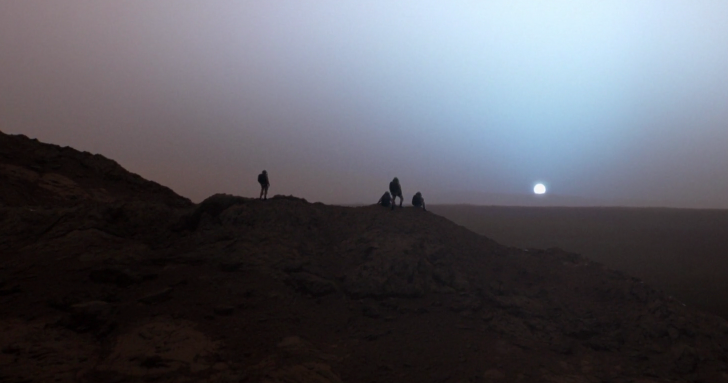
Using Carl Sagan's poetic musings on the forces that drive us to wander as his narration, Wernquist illustrates scientifically accurate worlds from our solar system and imagines how human occupants might work and play on these worlds. The result is spectacular.
Narration from “Wanders”
For all its material advantages, the sedentary life has left us edgy, unfulfilled. Even after 400 generations in villages and cities, we haven’t forgotten. The open road still softly calls, like a nearly forgotten song of childhood.We invest far-off places with a certain romance. This appeal, I suspect, has been meticulously crafted by natural selection as an essential element in our survival. Long summers, mild winters, rich harvests, plentiful game—none of them lasts forever.
It is beyond our powers to predict the future. Catastrophic events have a way of sneaking up on us, of catching us unaware. Your own life, or your band’s, or even your species’ might be owed to a restless few—drawn, by a craving they can hardly articulate or understand, to undiscovered lands and new worlds.
Herman Melville, in Moby Dick, spoke for wanderers in all epochs and meridians: “I am tormented with an everlasting itch for things remote. I love to sail forbidden seas …”
Maybe it’s a little early. Maybe the time is not quite yet. But those other worlds—promising untold opportunities—beckon.
Silently, they orbit the Sun, waiting.
Wanderers - a short film by Erik Wernquist from Erik Wernquist on Vimeo.
Possible Tasks / Lessons
Making Connections1. Review the images from "Wanderers" in the gallery (http://www.erikwernquist.com/wanderers/gallery.html). Explain which of the images best connect with the following terms: "wanderers" / "adventurers" / "colonists".
2. Read the narration for "Wanderers". Find earth based images to illustrate Carl Sagan's words. Find six images and justify how they connect to Sagan's ideas.
3. Bring to life one of the moments illustrated in the film. Using the text form of your choice (short story, news report, blog entry, narrative poem) tell the story of one of the adventures depicted in the film. Use a phrase from the film's narration as the title of your text.
Literary Elements
1. Carl Sagan was a scientist who wrote beautifully. Identify the most effective passage in text of his narration and explain how Sagan made use of figurative language to convey his ideas.
Media Literacy
1. Listen closely to Carl Sagan's performance of his text. Identify three moments in the recording that demonstrate effective speaking techniques. Explain why they are effective.
Subscribe to:
Posts (Atom)
Featured Post
Critical literacy lesson:
Poor Journalism: " Rise of women teachers 'turning boys off education' as report reveals girls born this year will be 75%...
